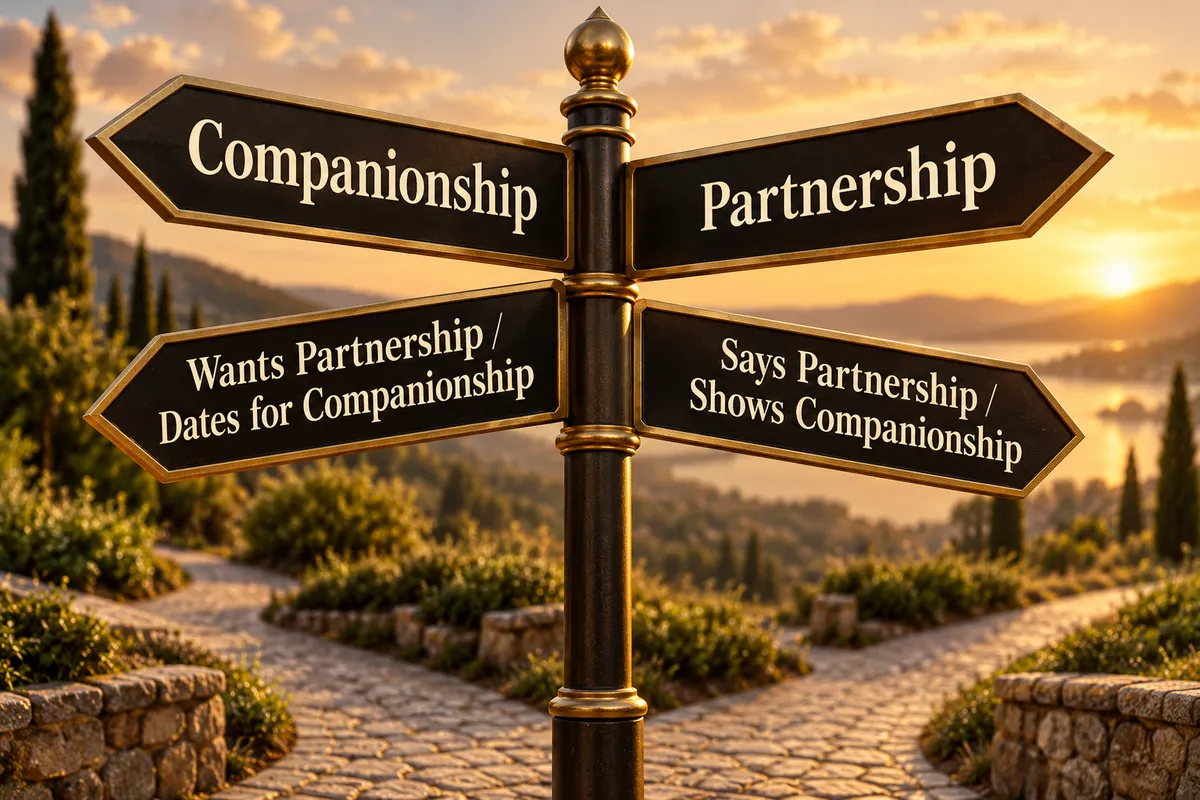
Partnership vs. Companionship: The 4 Ways People Date
Are You Dating for Partnership or Companionship?
Here’s something a lot of people do not realize:
Two people can both say they want a relationship and still be dating in completely different ways.
That’s one of the reasons dating gets so confusing.
You can meet someone who texts consistently, plans dates, spends time with you, is affectionate, says they want something serious, and still not know whether the two of you are actually building toward partnership.
Because companionship and partnership can look very similar in the beginning.
The difference is not just what someone says they want.
It is also how they date.
And the same is true for you.
You may genuinely want a life partner and still be using a dating process that mostly builds companionship.
That is the part I want you to pay attention to.
There Are Four Common Ways This Shows Up
1. You Want Companionship Only and You Know It
Some people genuinely just want companionship.
They want someone to spend time with.
Someone to talk to.
Someone to be affectionate with.
Someone to travel with, have sex with, share weekends with, or enjoy life with.
They may even want exclusivity.
What they are not necessarily looking for is someone to build a shared life with.
They may not want to combine lives, make major decisions together, work toward marriage, or take on the responsibilities that come with long-term partnership.
And there is nothing automatically wrong with that.
If that is what you want, and you are honest about it, great.
The problem is not companionship.
The problem is when one person thinks they are building partnership while the other person is building companionship.
2. You Want Partnership and You Date for Partnership
This is different.
You still care about attraction.
You still care about chemistry.
You still want to enjoy the person.
You still want fun, affection, friendship, connection, and all the good things.
But you are also paying attention to something else:
Can we actually build a life together?
That means you are learning things like:
Do we want the same kind of relationship?
Are our values compatible?
Do our lifestyles fit?
Does their behavior support what they say?
How do they handle money, family, responsibility, conflict, and commitment?
Do they have the capacity to participate in a healthy partnership?
You are not rushing.
You are not turning dates into interviews.
You are simply not leaving the most important information until after you are already deeply attached.
You enjoy the connection.
But you do not let connection make the decision for you.
Your dating process matches your goal.
3. You Want Partnership, But You Don't Know How to Date For It
This is where I see a lot of people get stuck.
You really do want a committed relationship.
You may even say:
“I’m dating intentionally.”
But then the process looks like this:
You meet someone.
There is chemistry.
You start talking a lot.
You spend more time together.
You get comfortable.
You start feeling connected.
You “see where it goes.”
And you hope it becomes the relationship you want.
You are not trying to choose companionship.
You may honestly believe you are dating for partnership.
But most of the attention is still going toward:
Do I like this person?
instead of also asking:
Are we actually compatible for partnership?
That is the difference.
Connection starts growing.
Time starts passing.
Feelings start developing.
But the information you need to evaluate long-term fit may still be thin.
So by the time something questionable shows up, you are already invested.
Now it is much harder to look at the information clearly because there is more to lose.
You wanted partnership.
But the process you were using did not help you evaluate partnership before the investment got bigger.
4. You Say You Want Partnership, But You Really Only Want Companionship
This one can be harder to spot.
Maybe the person says:
“I want something serious.”
“I’m ready for a relationship.”
“I want marriage someday.”
“I’m looking for my person.”
Great.
But then what happens?
Do they avoid conversations about direction?
Do they want closeness without the responsibility that comes with building a shared life?
Do they enjoy emotional or physical intimacy but resist conversations about compatibility?
Do they talk about a future without making choices that actually move toward one?
Do they keep the relationship going because they enjoy having you there, even when it becomes clear the two of you are not building toward the same thing?
Here is the uncomfortable reality:
Most people know that saying “I’m only looking for companionship” is going to significantly limit who is willing to date them.
Someone who wants a committed relationship may not stick around for that.
But saying:
“I want a relationship too”
keeps more doors open.
It can give someone access to the connection, affection, attention, intimacy, consistency, and companionship they want - without requiring them to be honest that they are not really looking to merge lives or build partnership.
Sometimes that is intentional.
And sometimes people may not be fully honest with themselves about what they actually want.
You may never know which one it is.
And honestly, you do not have to.
You do not need to read their mind.
You need to pay attention to the gap between:
what they say they want
and
what they are actually building with you.
If the words keep saying partnership but the relationship keeps functioning like companionship, that gap matters.
Before You Analyze Them, Look at Yourself
This is the part I really want you to think about.
It is easy to ask:
“Is this person serious?”
“Are they emotionally available?”
“Do they really want a relationship?”
Those questions matter.
But there is another one:
Does the way I am dating match the kind of relationship I say I want?
If you want partnership, ask yourself:
Am I learning whether someone is actually compatible before becoming deeply invested?
Am I asking the questions that matter?
Am I paying attention to behavior?
Am I allowing new information to affect my decisions?
Am I willing to stop when the evidence no longer supports continuing?
Or am I mostly:
building connection
enjoying attention
getting attached
increasing time together
becoming more intimate
hoping compatibility will work itself out later?
That difference matters.
You can sincerely want partnership and still be using a process that mostly builds companionship.
Partnership Dating Does Not Mean Turning Dating Into an Interview
This is where people sometimes get nervous about intentional dating.
They think:
“So I am supposed to sit across from someone with a checklist and interrogate them?”
No.
Partnership dating is still dating.
You laugh.
You flirt.
You enjoy each other.
You have fun.
You see if there is chemistry.
You let the relationship breathe.
But you are also learning on purpose.
You are not just asking:
Do I like this person?
You are also learning:
Do we have what it takes to build something healthy together?
That happens through both conversation and observation.
You ask.
You listen.
You watch.
You clarify.
You compare words with behavior.
You notice patterns.
You keep learning.
As You Get Closer, You Should Also Be Getting Clearer
You can become more connected to someone without becoming more clear about them.
That is where people get into trouble.
You are talking every day.
Spending weekends together.
Meeting friends.
Becoming physically closer.
Thinking about the future.
But ask yourself:
Do I actually know more?
Do I understand what they want?
Do I understand how they make decisions?
Do I know how they handle disagreement?
Do I know how they handle responsibility?
Do I know whether our values and lifestyles actually fit?
Dating does not need to give you every answer immediately.
But if intimacy is growing while clarity is not, pay attention.
Connection should not be growing while clarity stays exactly where it was on day one.
Do Their Words and Behavior Actually Match?
Someone can say all the right things.
That is useful information.
But it is not enough.
They may say they want commitment.
Great.
What does their behavior show?
Do they follow through?
Do they participate in important conversations?
Do they respect your boundaries?
Do they show curiosity about your life?
Do they make room for you?
Do they handle disagreement with maturity?
No one is going to do everything perfectly.
You are not looking for perfection.
You are looking for a pattern.
Do their actions generally support what they say they want?
And if something concerns you, do not stop at the explanation.
If they say:
“I didn’t realize that bothered you.”
What happens next time?
If they say:
“I’ve been overwhelmed lately.”
Does the behavior change when life settles down?
If they say:
“I’m working on that.”
Do you see evidence that they are?
You do not have to assume someone is lying.
But you also do not have to stop paying attention because the explanation sounded reasonable.
Words can explain behavior. What happens next helps you see whether the explanation holds up.
Dating for Partnership Means Using What You Learn
Gathering information is not enough.
You have to use it.
Ask yourself:
What do I know?
What don’t I know yet?
What does the evidence support?
Does what I am learning support continuing?
Sometimes the answer is yes.
So you keep going.
Sometimes you need more information.
So you ask another question, observe more, and give it time.
And sometimes something does not align.
That matters too.
Because once you really like someone, you may want the information to mean something different.
But partnership dating requires you to let the evidence matter.
The Goal Is Not to Become a Detective
You do not need to analyze every text.
You do not need to decode every pause.
You do not need to become suspicious of everything.
Your job is simpler than that.
Pay attention to what you are learning.
Then use it.
Because dating for partnership is not about finding someone you like and hoping it works.
It is about allowing two people enough conversation, observation, and real-life experience to learn whether they can actually build something together.
If Partnership Is Your Goal, Your Dating Process Matters
Wanting partnership is not enough.
You need a dating process that helps you evaluate for it.
That means learning how to:
get clear about the partnership you want
recognize partnership capacity
gather meaningful evidence
understand what the evidence actually shows
make clearer decisions about when to keep exploring, slow down, invest more, or walk away
That is the work behind The Dating Alignment Method.
Because partnership does not start when you become a couple.
It starts with how you date.


